
|
Engine Work
Hey MotoMan:
I'm a racer in WMRRA
& OMRRA [Washington & Oregon, USA] racing organizations. I am
one of the top competitors in the northwest, but had been plagued with under
horsepower machines. I have watched [Mototune]
competitors such as Alan Schmidt, Dave Cook kick my ass down the straight and
quite frankly I am sick of it.
For
the 2002 season, I want to be able to be competitive down the straight not
just the corners. I have seen what your motors have done out on the
track, so there is no question on who I would like to use to build my motor.
I just need you to answer a few questions. How much does it cost to have you build a
supersport motor?
How much does it cost to ship a motor?
What kind of time frame do you need?
How much horsepower are you getting out of the
new GSXR-750's.
If I purchase another bike, and have you build
two motors for me--is there a price savings?
Information ?
~ Mark
Hi Mark !!
Thanks for the awesome testimonial for Mototune !
I originally started the Mototune USA website in late 1999 to promote
Mototune (my engine building business.) In the past year, the website has really taken off, and
recently I've had over 900 e-mails from people who've wanted me to build their engines. It
would take me 30 years to build that many motors !
I can't do both anymore, so I made the decision to quit building engines, and do the
Mototune USA website
full time. Power News is promoting both sports of street motorcycling and roadracing.... we're making it go "mainstream"
!!
I know it's hard to find good engine tuners. A big part of the problem is that there's a lot of misinformation about motorcycle
performance in books and magazines. The secrets you'll learn here in the Power News newsletter
will level
the technological "playing field". People from all over the
world will be able to build bikes that
are as fast as Alan
Schmidt's and Dave Cook's.
If you don't want to do the engine work yourself, I'd recommend finding
some mechanics you can trust, and tell them to sign up for Power News !
Sincerely,
Pat McGivern
~MotoMan~
   
5 Stars !!!!!
Hey MotoMan, awesome site packed with great info !
I just got a new GSXR1000....I have to admit, I'm a little skeptical about your break in procedure,
although it does make sense......
Its just hard to go against the manual after paying 9000 dollars for it, being 20 years old that's a lot of loot, but anyways,
AWESOME SITE!!!
5 STARS!!!!
~ Corey
Hi Corey !
Thanks for the high rating
!!
It's true: my "Break in Secrets" method
is definitely the way to get the most power & best ring seal for your
new Suzuki !!
A word of
warning: Everything
you're going to read on Power News is hard-to-believe, and will tend to make you skeptical !!
The way
Mototune was able to beat the performance of the factory racing teams, was to do
everything differently
than others do it. But, just like the "Break In
Secrets" article, once you understand the ideas, it will make
more sense than the "cutting edge" information you
find in magazines.
Please tell all of your riding friends to subscribe to Power News !!
Thanks,
Pat McGivern
~MotoMan~
   
|
|
Misinformation
756,220 to 1 !!
If you type the words "Intake
Porting" into the Alta Vista search engine,
you'll find an incredible
756,220 pages on the topic !!
Every one of those pages will tell you the exact
opposite of what
I'm going to teach you today.
The odds are overwhelmingly against the MotoMan on this one:
That's over
Three-Quarters of a Million against 1 !!
(That's not including another
'zillion' books, magazines and other tuners...)
|
The Honda Hawk Experiment
In January of 1992, I first
studied the effects of porting on my own race bikes, and made a huge
discovery. It worked so well, that after a summer of working on other
people's bikes, I could show up at the local racetrack in August with no practice
and easily win races.
At Daytona in 1993, I was able to test my idea against the best in
America. Like every fast Hawk rider at
the time I had the 700 cc (3 mm over) piston kit, a pipe and the popular
racing cams. My carburetors and everything else inside the engine was
stock, except for my secret porting trick.
The competition ?? The top racers had their Hawks built by a company
called Two Brothers which, based on their huge success with Hawks, went on
to become a semi factory Honda race team.
Gridded on the very last row, I came out of turn
one in last place out of 43 riders !! (I always freaked out on starts)
Once the tires warmed up, I realized I could easily out accelerate the Two
Brothers bikes as well as everyone else in the race. At one point, without using the draft, I passed 11 of my
fellow Hawk riders at once on the fastest part of the banking. In the
short 4 lap race, I passed 38 riders to take 5th
place Expert in my first time at the track.
Since then I've ported about 100 heads from every major brand and type of
4 stroke engine. The result has been shattered lap records, countless USA
roadracing championships, and another 2 in
Europe. On the street, I've built a few real "sleepers" in the
USA, and created a genuine "street legend" in the Dominican
Republic !!
There was no way I could hide the evidence of this porting technique, and
it's amazing results, so I thought for sure that it would only be a matter of months before
everyone else caught on. I was convinced that the advantage of my new "secret
weapon" would be over by early 1994.
It's been exactly 10 years since my discovery, and with very few
exceptions, no one else has gotten it.
How could that be ?? Motor sports are supposed to be so ultra competitive
that no one can hold an advantage for long. With the vast manpower &
financial resources of the big racing teams, how could 1 guy from
Wisconsin hold onto all the chips for 10 years??
It made me realize that there are similar situations like this in every
endeavor all over the world. That's why I came up with the motto "get
past the cutting edge". I'm here to tell you that the "cutting
edge" is artificial, and whatever you do, you can beat the best. No
one's unbeatable at anything, once you truly understand the power of
thinking outside of the box.
I've realized that the answer to how easily I was able to protect
my "secret" ... really lies in an understanding of human nature.
The information I'm going to share with you will certainly change the face
of engine performance & technology. I also sincerely hope it will
inspire you to look deeper into the ways that we "automatically
think" ...
... without ever actually thinking. |
|
The Magical Myth of Flowbench
- Porting
 |
Once upon a time...
The flowbench is a machine that measures the airflow through the ports by sucking air thru like a
vacuum cleaner. The vacuum gauges on the bench actually measure the resistance to the
flow thru the ports, and the result is converted into CFM.
That means "how many Cubic Feet
of air will flow through the port per Minute." |
|
|
|
Anyone who buys a flowbench and
a dremel tool is "qualified" to flowbench - port heads. The Superflow flowbench owner's manual
says that:
" For
every 1 CFM of increase in intake flow,
you'll gain .43 horsepower. "
If you want more water to flow through a pipe, just make the pipe bigger.
There's something wrong with this though. |
|
|
It's easy to understand why so many
people automatically think Flowbench - Porting, or "more is better"
is a way to improve power.
,
Without closer examination,
it seems quite logical. |
|
|
Okay,
Let's examine it a little closer !!
We were all taught to think of a 4 stroke engine by the traditional textbook
explanation of
Intake, Compression, Power & Exhaust.
Textbooks and magazines achieve a sort of instant credibility that comes
from the association with $$.
Example:
"This
source must be right ... after all, there's obviously
some big money behind it
..."
Because of this association, the vast majority of people never question
the things they learn in school, or read in mainstream publications.
In the last issue of Power News you learned to
think of a four stroke engine in a whole new way... 8
Phases !!
In the 8 phase engine article,
you'll remember that the intake "stroke"
actually consists of 3 phases.
( Overlap, Suction and Charging. )
|

,

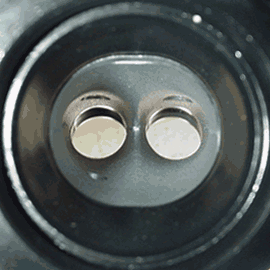
Stock Yamaha R6 Intake Port
|
|
Uh - Oh ...
It turns out that a flowbench measures the least
important aspect of intake cycle
efficiency !! |
|
|

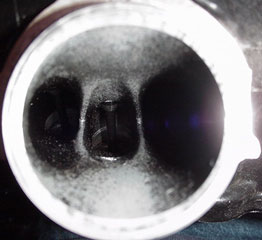
Stock Yamaha R1 Intake Port
|
It's true !!
When you stop to think about it, a
flowbench only measures the efficiency
of the "suction phase".
That's not the right
thing to measure.
Why ??
Because, it doesn't matter how well
the cylinder is filled at that
point in
the intake cycle !
|
|
What ... that sounds crazy
!!!
It's 100% true ... it's simply a matter of the sequence of
events ! The success of the last event, the charging phase, determines the
success of the entire intake process.
What happens when a low velocity port fills
the cylinder really well, but too early ?? The result is a slower intake charge
that stops flowing into the cylinder. Then some of the charge gets pushed back
out of the cylinder and into the port as the piston returns up the bore
during the intake charging phase. The gain in flow doesn't offset the loss in port velocity.
.
|
Here's an analogy:

It's just like a roadrace; you can lead for 3 laps, then run out of
steam and end up in 7th place.
In racing, only the last lap counts, because the one who leads at
the checkered flag wins.
In the intake cycle "race" the last lap is the charging
phase,
and the checkered flag is the intake valves closing. |
So in the final result, the first 2 phases don't matter if the 3rd phase is unsuccessful !! The
total intake volume that will be burned is determined by the amount that
remains in the cylinders
after the
intake valves close. That means that an early gain during the suction phase can
be easily lost during the charging phase. And, if the intake charge returns back into the port during the piston's upstroke, the result is
going to be a
net loss !!
It gets worse !
On a carbureted bike the reversing charge will create an effect
called double carburetion, which means the mixture will become even richer
with fuel as it passes back over the main jet nozzle for a second time.
Have we lost enough power yet ??
Wait... it gets even worse !!
Here's a real "out of the
box" idea:
high flow ports also flow really well
backwards !!! All that work on the flowbench comes back to haunt you when the piston
now has even less resistance to pushing the intake charge back into the "
high flowing port " !!!!!!! When you begin to consider the
consequences of all this, the whole idea of "more flow is
better" comes crashing down like a lead balloon.
What's The Secret ??
Using the race analogy, if you increase the
Port Velocity,
by making the port smaller,
the intake cycle "race" starts out slower, gains momentum and
makes a tremendous charge on the "last lap" to overtake the high
flow port and win the "race". The interesting thing is, this
type of port will always lose in a flowbench contest !!!
|
|
|

.
.
Remember
The Scientific Method:
Evaluate
one
set of conditions. Make only
one
change, test the result and compare
it to the first set of conditions.
|
Hey MotoMan,
If "they" could put a man on the
moon,
why hasn't anyone else
thought of this before ?!?!
One reason is that people only think of
"Scientists" as
scientists. Everyone can and should be a scientist !! That means you !!
In real world situations, many people forget to apply the simple principle that all productive science is
based on: The Scientific Method.
When someone builds a superbike engine, they
usually port their cylinder heads and make other modifications like
higher compression, valve job, different cams and big bore kits.
The combination of all these modifications usually results in a net gain in
power. The problem with attributing a gain to the porting in this scenario, is that it goes against the scientific method, because there are 4
other variables coming into play.
Know the difference between association and causation
!
In this case, flowbench porting of the cylinder head has been associated with horsepower
gains for so long that no one bothers to question it. That doesn’t mean the porting actually caused
any of the gain.
Could
More Flow = Less Power ??
Flowbench Porting has always been associated
with more power... Superflow even says more flow equals more power in
their official owner's handbook !!
Yet, in most cases, Flowbench Porting motorcycle
heads actually results in less
power!
(Actually, a few creative
thinking tuners in Europe do already know about this. They're not anxious to
reveal this info, because their success on the racetrack is somewhat dependent
on it remaining a secret.)
|
What happens when
we apply the scientific method to intake porting ??
To find out, let's
test 2 progressively smaller
porting specs against a stock head,
without changing any
other variables ...
I chose the Yamaha R6 for this test,
because it has the least flow and the smallest
valves of all the current 600's !!
Then I asked the question:
Are the stock ports still way too
big ???
|
|
The Verdict ??
Smaller Volume
=
Higher Velocity
=
Better Power
By reducing the intake port
size by 30 percent:
The Yamaha R6 increases 5 hp. from 103.1 to 108.3
That's a 5 percent gain in top end power !
Notice that the power gain at 8,000 is from 60 to 65, also 5
hp...
That's the same hp increase, but it's actually an 8.4 percent gain where it makes
the biggest difference, at the turn exit.

30% Smaller Ports
make the most midrange & top end
power !!
|
-
Stock Ports 103.1 HP
- 20% Smaller
Ports 104.1 HP
-
30%
Smaller Ports
108.3 HP !!
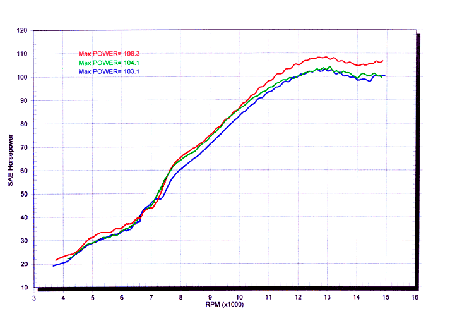
Click Here For The Full Size Version
|
How
do High Velocity Ports
work
on the racetrack ??
" Incredible !!
"
|
With most common superbike modifications, the rear tire either spins up
too fast and threatens to highside you, or it grips and ungrips,
which makes
the bike drift
wide and run off line.
Either way, the
rider has to wait longer to roll on the throttle !!
What's the point
of modifying an engine if you can't actually use the new found power
?
The enhanced power delivery of the
High Velocity Intake
Porting
allows for
perfectly controlled rear wheel sliding, which is actually
more
important than the gain in peak power !!
|
|
600 Lap Record Smashed on
a Borrowed R6 !!
In May of 2000, Derek
Shoeberle borrowed an R6 from one of my customers. On that super windy
Sunday in May, the races were dominated by the man on the mysterious red
bike. Not only did Derek smash the 600 record, he came within 0.88 of a
second of the overall motorcycle lap record ...
... which was set in 1993 by
an FZR 1000 with Mototune High Velocity Ports !!
|
|
High Velocity Intake
Porting
A power improvement that enhances your suspension, and dramatically
improves rear tire traction !!
In addition to the overall peak power
gain, the biggest advantage of Mototune High
Velocity Intake Porting is
its perfectly linear
power delivery. When you open the throttle two percent, you get exactly
two percent more horsepower, then when you want ten more, you get
exactly ten percent.
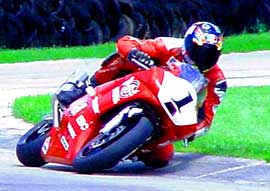
When you look at the photo, notice how
Derek's confidently turning the throttle on while he's still at his
outrageously steep lean
angle ... through one of the bumpiest turns in roadracing. That's smooth power !!
Super - predictable mid range power delivery makes it
easy for anyone from novice to expert to get incredible drives off of turns, since the power
doesn't break your rear tire loose like it does on most superbikes. It
doesn't take much practice to turn the throttle harder, it just
intuitively feels right when the power is so smooth.
That Confidence Makes a Huge
Difference in Your Lap Times
!!
The increased driveability and top end speed
from
the High Velocity Intake
Ports allowed Derek to ride at
an entirely new level. During this race he absolutely smoked 2nd place, and turned an incredible
1:13.88, lowering the Blackhawk 600 lap record by over
1 second
on a very windy day !!
|
Derek Shoeberle Powers Through Blackhawk Farms Raceway's
Notoriously
Bumpy Turn 4.

" High Velocity Intake Ports
Are Incredible !! "
|
What if your head's already been flow bench ported ??
|
CBR 600F3
Before
&
After
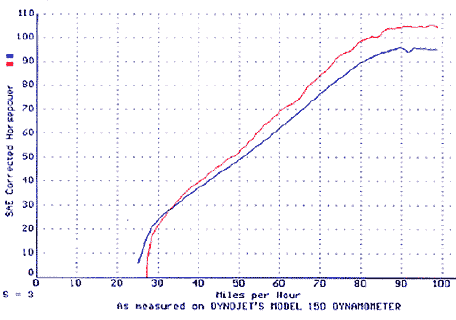
The
Blue Line represents a cylinder head that was "flow bench ported"
by a well known U.S. motorcycle performance tuning company.
The
Blue Line shows that enlarging the
stock intake ports a small amount, caused this engine to lose power throughout the entire power curve.
The good news is, The Red Line
shows that after fixing the "flowbench ported" head by
making the ports
35% smaller... this CBR 600F3 gained more than 10 HP !!
Since
The Blue Line's
head ports
were already "flowed out" even bigger than stock, there was
about an extra 3 horsepower recovered.
In this case, a stock head would have worked better than the flowbench ported head.
|
Flow
Bench Porting usually costs
around $500 - $1,000 ...
,It's
a total waste of money !!
This
dyno graph dramatically shows the power loss caused by lowered intake port
velocity:

Note:
The difference at the beginning of this dyno graph is because the dyno
operator opened the throttle for the red run at a later rpm point than the
blue run.
The comparison isn't accurate until both runs are at full throttle and
full power, which is at about 35 mph on the graph.
|
Remember:
More Flow Doesn't Always Equal More Power !!
But
Less Velocity Usually Equals Less Power !!!
How does
Misinformation
go unchallenged ??
1) Failure to use the scientific method !!
2) A lack of critical thinking about existing information !!
3) Follow the leader mentality !!
4) Fear of being different !!
5) Blind trust in books and magazines !!
6) Mass marketing !!
7) Because changing the way you think is scary !!
8) All of the above !!
(Of course, the correct answer is #8)

|
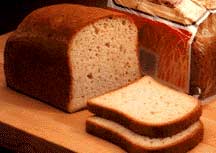
" It's Time Somebody Did
Something About Bread !! " |

Warning:
Bread is Evil.
|
|
Did you know:
1) More than 98 percent of convicted
criminals are bread eaters !
2) Exactly half of all children who grow
up in bread - eating households score in the
bottom 50% on standardized IQ tests !
3) In the 19th century, when virtually
all bread was baked in the home, the average
life expectancy was less than 55 years; infant mortality rates were
unacceptably high; many women died in childbirth; and diseases such as
typhoid, scarlet fever, smallpox and influenza ravaged entire nations !
4) Statistics show that more than 75 % of violent crimes are
committed within 24 hours of eating bread !
5) Bread
is made from a substance called "dough." Researchers have proven that
as little as one pound of dough can choke a large animal like a horse. The
average person eats more bread than that in
one month !
6) Bread
is known to be extremely addictive. Subjects deprived of bread
and given only water, actually begged for bread
after just two days !
7) Bread
is a "gateway" food item, which usually leads to such items as
butter, jam, peanut butter and even ... bacon !
8) Bread
has been proven to kill. Scientists have now uncovered alarming evidence that 100%
of the people who eat bread will eventually
die !
9) Unattended newborn babies can choke
on bread !
10) Bread
is baked at temperatures as high as 425 degrees Fahrenheit ! Don't
laugh...that kind of heat can kill a full grown adult in less than five
minutes.
11) 96 % of cancer victims eventually admit
that they've eaten bread !
12) Sadly, 9 out of 10 bread eaters are
unable to distinguish between significant scientific fact and meaningless
statistical babbling.
(Not Critical Thinkers Like You !!)
|
|
|
Misinformation
One
could argue that every one of these individual "factoids"
about bread is "true." The way the "factoids" compare
bread
with
danger, and the use of
official - statistical
- scientifical sounding words cause the unthinking reader to make connections of logic that aren't true.
.
The only one that's true is
#12.
The others falsely imply new
information that really isn't there !!
(The very real problem is that
much of the information in our modern society is presented this way.)
, |
|
Don't Miss The Next Issue:
Learn How To High Velocity Port
Your Own Cylinder Head !!

Whoa ...
There's 15 More Back
Issues !!
For Best Results, Read Them All:

|