 |
R6
Speed Trix |
This edition of Power News is all about the ’99 and ‘00 AMA
Supersport R6’s
Mototune built for Team Yamaha Norway’s Thorvald Saeby.
Both R6's were built and tuned to exactly the same AMA Supersport specifications,
using Nutec
fuel and an Akropovic exhaust system.
|
The
Official 2000 F USA 106 hp. Class
Dyno
Produced Higher HP Readings.
In 1999 we had 101.8 peak Dynojet
H.P. and in 2000 we had 110.9. We didn’t
do anything new to make 9.1 more horsepower, and both bikes had the same
speed. The 2000 dyno just gave everyone's bike 9% higher readings.
We’ve built 15 other Supersport R6’s that made anywhere from 104 to
112 peak HP on 15 different dynos around the USA. All 15 Mototune R6's
would be within half a horsepower from idle to redline if tested on the
same dyno at the same time.
About Dynos:
They're great for testing changes on one bike or comparing
multiple bikes, if the tests are done back to back on the same dyno,
on the same day, and with no changes in air density.
|
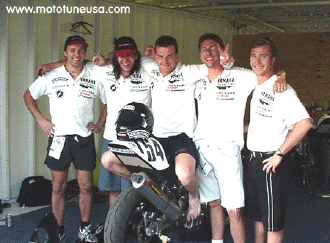
2000 TEAM  

From L to R: Gorm Oye, Jorgen Johnsen,
Thorvald Saeby,
Pat "MotoMan" McGivern, and Greg Moon.
|
|

Thorvald Saeby
Mototune's Daytona Test Pilot
|
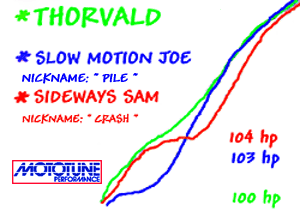
Here's a
comparison of the power curves of 3 exhaust pipes on a stock engined R6.
Each pipe was optomized for jetting and dyno tested back to back.

The green curve is the Akropovic. Since then we've tested the Yoshimura
Duplex pipe and found it to produce a clean power curve like the Akropovic. |
|
Speed Without Horsepower ???
The Mototune R6 has lot's of
horsepower! But roadracing is
really more about the bike’s power delivery, since that affects your
traction on the turn exits and your drives onto the straightaway. This is
critical for 5 reasons:
1)
Your speed all the way down the straight depends on your turn exit speed.
2) When you can out drive other riders’ just as you enter the
straightaway, they lose the opportunity to draft and pass you back at the
end of the straight.
3)
How often have you gotten stuck behind a backmarker and lost momentum??
4) Everyone blows
a turn once in a while and gets stuck in the wrong gear.
5) Like it or not, sooner or later you’ll be racing in the rain…...
These are the
realities of racing !!
If you’re going for a championship, you need a
bike that’s capable of winning in real race conditions.
|
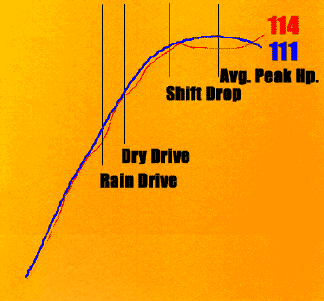
The 114 HP R6 V.S.
The 2000 Mototune R6

I don’t have an actual dyno sheet that compares The 114 HP
R6 to The Mototune R6, so I
made a graph to help explain the speed advantage we had. It’s pretty
accurate as far as the peak numbers and shapes of the 2 curves.
The 4 vertical lines represent the 4 key
RPM zones of the Mototune race strategy. |
|
|
R6 Shopping List
Improving on the basic power curve starts
out with the right tuning. R6's are extremely sensitive to exhaust system
and jetting. There's nothing an engine builder can do with the
motor to compensate for the wrong exhaust system or jetting set up.
Exhaust Systems
So far, I've tested 7 different brands of exhaust systems. Yoshimura
and
Akropovic are the only pipes I've seen that will give you the tractable
power characteristics and
the high average HP of The Mototune R6.
Air Filter
Good News! You already own the best R6 air
filter ... stock Yamaha ! Keep it clean by washing it in
dishwashing detergent, never use gas or other solvents.
Be sure it's completely dry before you reinstall it. (no oil or water)
Jetting Set Up:
Fuel Screws: On U.S. models you’ll have to
first drill into the brass plug that blocks the pilot screw access, then
use a sheet metal screw to pull out the plug. Carefully clean out all the
chips, and turn the screws in until they lightly seat. Back them out 2 1/2
– 3 turns from there.
Needles: use a .020 inch (.5 mm) washer to raise the stock needles. Make
sure the washer is no larger than the diameter of the needle top, or it
won't seat in the bottom of the slide correctly.
Main Jets: Keep the stock stagger, and increase the main jet
1-3 half step sizes richer (depending on temperature, humidity
and elevation) Always use stock main jets, aftermarket jets use a different
calibration system.
|
|
Spinnin' in the Rain
|
Rain Drive
7,000 - 9000 rpm
On a wet track, your bike's bottom end
acceleration curve is super critical. This is the first key area I
concentrate on. Whenever the arc of the power curve changes, the bike
accelerates at a different rate. In wet conditions The 114 HP
R6's
tire will break loose easier, because it goes through 3 different rate
changes during acceleration from 6,000 – 9000 RPM. The Mototune
R6's
linear power delivery is clearly the winner in the rain.
Even in the dry this rpm range is important. Have
you ever set up a guy up for a last lap inside pass, get in a little too
hot and accidentally select 3rd gear instead of 2nd
???
It’s hard to recover from that on a
600, because they’re notorious for lacking balls around 7-9000 RPM.
Plus, usually you have to wait until the bike settles before you can make a
downshift. The natural reaction on a 600 is to pin the throttle as soon as
possible to get it back in the power. The 114 HP
R6 is weak in this range, so if you get stuck in too high a
gear, the
competition will drive right back past you !!
|

The Low End Power’s Gotta Be
Torquey, But Most Importantly Ssmmoooooth.
|
"Drag Racing"
|
Dry Drive
9-12,500 RPM
Dynos measure power as if the bike were accelerating straight up and down
and 100% hooked up...
like a roll - on drag race.
|
|
When you think about it, the "drag race" in
roadracing really starts out at the turn apex from max lean angle,
maintenance throttle and nearly zero extra traction. ( "Maintenance
throttle" is just the 1/16 th of a turn on the throttle to keep the
front and rear tires evenly weighted.)
At this point the rear tire can’t take any more horsepower over
"maintenance throttle" or it will get sideways. As you start to
straighten up the bike, more power can be rolled on, but it’s still easy
to overpower the tire because there’s so much available power against a
lot less traction.
A hard drive with The 114 HP
R6 will result in a
series of small slide - hook - slides that scrub off speed. Any time the
tire gets sideways the "drag race" has to wait until the rider
can regain control of the power / traction equation, either by rolling off
or having to delay the drive out. Since The Mototune
R6's drive starts earlier,
you can pull an immediate gap to break the draft. Racers and tuners that
concentrate only the peak HP number aren’t considering the exit speed
they’re giving up !
|
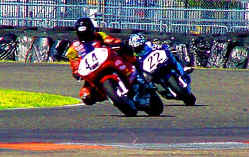
Here Thorvald Saeby
and Tommy
Hayden
"drag race" out
of Daytona's slick horseshoe turn during
2000 AMA 600 Supersport timed practice.
Rumor has it that Tommy's Factory R6 had 117 Hp !!!
Regardless of their bikes' Peak HP... both riders are in the "Dry
Drive Zone" of the rev range right now.
( Thorvald actually turned
faster lap times in this session on
The Mototune R6 ! ) |
|

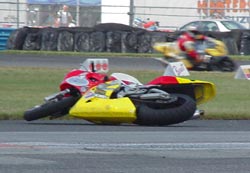
Another riderless R6 slides past
MotoMan's camera.
|
The Daytona
Horseshoe turn is a popular spot for highside crashes !! |
|
Average Peak Horsepower
Once you’ve fully exited the turn and the bike is 100% hooked up and driving, the
average peak horse power comes into play. The peak
horsepower number can be deceiving… especially on an R6. They have a
unique power curve that actually peaks twice, at around 12,000 and then again
just as it hits the rpm limiter. We found a way to fill in the big valley
between The 114 HP R6's 2 power peaks. It's
a combination of cam timing and friction reduction. It cost us the big peak
number, but the advantage is obvious....The Mototune
R6 keeps on increasing
speed over The 114 HP R6 through 3rd, 4th, 5th,
and 6th gears.
|
Put it All
Together for the 172 Mph Run.
At Daytona The Mototune R6
smokes The 114 HP
R6 through the
"dry drive range" out of the chicane, enough to pull away and
out of drafting range. Next it used it’s higher Average HP through the
gears to reach the critical ram air speed of 130 mph at an earlier point
on the banking.
Then as the bike comes off NASCAR turn 4, the motor is
laboring the hardest… the middle of 6th gear at 12,500 RPM.
The high speeds of Daytona's banking create unbelievable centrifugal force
on the tire that can increase the outer diameter by as much as 3 inches.
Tire growth makes the effective gearing of your bike even
"Taller"!!!
At this point getting to 172 mph is all about the struggle to push through the 155 mph aerodynamic
blast.... The 114 HP R6
power falls flat and it revs out slowly. It simply doesn't have enough
time or steam to pull to 172 mph.
The Mototune R6 is
pulling hard coming off NASCAR turn 4. It's in the meat of it’s power
advantage, and the higher speed built up to that point adds extra ram air
horsepower for the 172 mph run to the checkered flag.
|
The Average Peak
Horsepower covers the range from the shift drop up to the rev limiter.
 |

|